Industrial inkjet printing costs rarely fit into a single price per print. The real figure depends on equipment, ink usage, substrate, production speed, labor, maintenance, and energy consumption. A short product code may cost only a fraction of a cent, while a large-format package design can require much more ink and drying time.
When manufacturers ask, “how much does industrial inkjet printing cost,” they often focus on the printer’s purchase price. That is only one part of the calculation. A reliable estimate should include printhead replacement, cleaning cycles, software, ventilation, operator training, and planned downtime. Even small details matter. A dusty conveyor can reduce print quality and increase maintenance work. An unsuitable substrate may cause bleeding, smearing, or repeated production runs.
The most practical method is to calculate total cost per printed unit. Record daily output, ink consumption, labor hours, electricity use, rejected products, and service expenses. Then compare those costs with the current printing process. Real production data is more useful than a supplier’s best-case example.
A neat spreadsheet can still mislead.
Ink coverage changes between jobs. Seasonal demand changes machine utilization. Some costs are easy to overlook, especially waste and technician travel. Therefore, this guide presents a transparent framework for estimating industrial inkjet printing expenses, while recognizing that every factory has different operating conditions. Use measured figures whenever possible, review assumptions regularly, and leave room for unexpected maintenance. Perfect predictions are unlikely. Better decisions are still achievable.
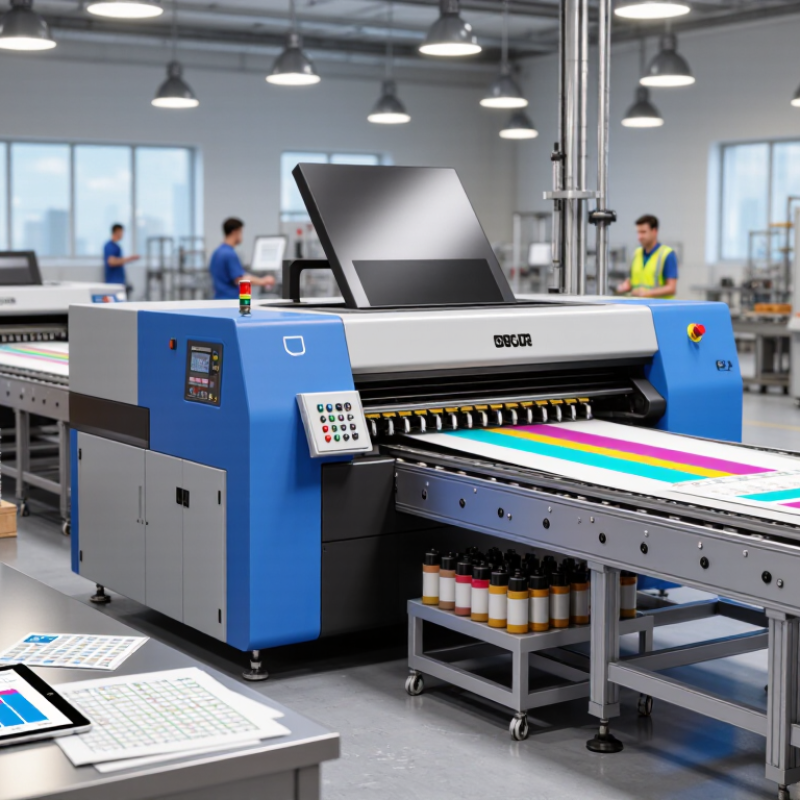
Define the Main Cost Elements in Industrial Inkjet Printing
Industrial inkjet printing costs begin with more than ink consumption. A reliable calculation separates fixed costs from variable costs. The main variable is ink, measured by milliliters per square meter. Coverage, drop size, purge cycles, and white ink can change this figure sharply. Substrate is often the largest direct expense. A small price increase for coated film or ceramic material can outweigh savings from faster printing.
Equipment cost must also be converted into a cost per printed unit. Include depreciation, financing, printhead replacement, software, and planned maintenance. Energy matters, especially with dryers, curing systems, and compressed air. The U.S. Department of Energy notes that industrial motor systems can represent more than 20% of facility electricity use, so dryer efficiency deserves measurement. Labor includes loading, color adjustment, inspection, and cleaning. Add waste from nozzle failures, setup sheets, rejected products, and production stoppages. These costs are easy to miss.
Industry data gives useful context. Grand View Research valued the global digital printing market at approximately 35.7 billion dollars in 2023 and forecasts a 6.7% annual growth rate through 2030. Smithers also reports continued expansion in industrial inkjet applications, including packaging and product decoration. Higher volume does not automatically mean lower cost. A practical formula is: total monthly cost divided by sellable output. Not printed output. The weak point is usually waste data. A spreadsheet may look precise while ignoring ten minutes of daily purging. Measure actual usage for several weeks, then revise the estimate.
Measure Ink, Substrate, Energy, Labor, and Maintenance Usage
How to Calculate Industrial Inkjet Printing Costs
Industrial inkjet costs begin with measured consumption, not cartridge price. Record ink used per job, including purges, start-up waste, and nozzle recovery. A practical formula is cost per square meter equals ink, substrate, energy, labor, and maintenance divided by sellable output. My early estimates ignored rejected sheets. That error made profitable work look better than it was.
Substrate often dominates the calculation. Track actual roll or sheet usage, trim loss, coating, and moisture-related waste. Smithers’ digital printing market reports identify packaging and industrial applications as major growth areas, where substrate variation strongly affects production economics. Use the supplier invoice, not a standard price list. Measure every batch. A five percent waste assumption may be too optimistic for short runs.
Energy needs a meter near the press. The U.S. Energy Information Administration reported average industrial electricity prices of about 8 cents per kilowatt-hour in 2024. Multiply measured kilowatts by run hours, then include curing, air systems, and standby time. Labor should include loading, inspection, color checks, and cleaning. Maintenance requires more than replacement parts. Count technician hours, scheduled downtime, fluid disposal, and printhead recovery. Reliability reports from industry associations repeatedly connect preventive maintenance with fewer interruptions, but the savings vary by application. That uncertainty deserves a visible allowance.
How to Calculate Industrial Inkjet Printing Costs - Measure Ink, Substrate, Energy, Labor, and Maintenance Usage
Illustrative production-cost model based on 10,000 saleable square meters per month
| Cost Category |
Usage Metric |
Monthly Usage |
Unit Cost |
Monthly Cost |
Cost per m² |
Calculation Basis |
| Ink |
Milliliters per m² |
95 L |
$70.00 / L |
$6,650 |
$0.67 |
9.5 mL/m² × 10,000 m² |
| Substrate |
Purchased substrate per saleable m² |
10,400 m² |
$1.20 / m² |
$12,480 |
$1.25 |
10,000 m² × 1.04, including 4% waste |
| Energy |
Electricity per m² |
3,200 kWh |
$0.15 / kWh |
$480 |
$0.05 |
0.32 kWh/m² × 10,000 m² |
| Labor |
Direct production hours per m² |
100 hours |
$28.00 / hour |
$2,800 |
$0.28 |
0.010 labor hours/m² × 10,000 m² |
| Maintenance |
Allocated maintenance reserve per m² |
10,000 m² |
$0.08 / m² |
$800 |
$0.08 |
Routine cleaning, service parts, and scheduled inspections |
| Estimated Total Production Cost |
$23,210 |
$2.32 |
Per 10,000 saleable m² |
Calculation Notes:
Cost per m² is calculated by dividing each monthly cost by 10,000 saleable m². The model includes a 4% substrate waste allowance and represents direct operating costs only; financing, depreciation, rent, packaging, overhead, and taxes are excluded.
Calculate the Cost per Printed Unit or Production Run
Calculating cost per printed unit starts with the production run, not the printer’s hourly rate. Record ink consumption, substrate, electricity, labor, maintenance, setup time, and rejected prints. Then use this formula: total run cost ÷ saleable units = cost per unit. Include fixed costs carefully. Depreciation, software, and service contracts may remain unchanged across short runs.
Consider a 10,000-unit order. Ink costs $0.018 per unit, substrate costs $0.072, and direct labor adds $0.025. Setup, maintenance, and energy total $310. If 3% of sheets are rejected, only 9,700 units are saleable. The calculation becomes ($180 + $720 + $250 + $310) ÷ 9,700, or about $0.15 per printed unit. That result is more useful than dividing by 10,000.
Small details change the answer. A longer warm-up increases energy use. A clogged nozzle can raise waste. The first estimate is rarely perfect. Track three real runs before setting a standard rate. Smithers reported that the global digital printing market was valued at approximately $136.7 billion in 2022 and could reach $230.5 billion by 2028, showing why shorter, variable production runs deserve closer cost control. The 2024 State of the Industry report from PRINTING United Alliance also highlights continuing pressure from labor and material costs. Recheck assumptions quarterly. Your spreadsheet may still be wrong.
Include Equipment Depreciation, Waste, and Operating Overheads
How to Calculate Industrial Inkjet Printing Costs
A reliable cost model starts with equipment depreciation, not ink alone. Divide the printer’s purchase price minus its expected residual value by its productive service hours. Include installation, curing units, finishing equipment, and approved upgrades. A machine costing $180,000, with a $20,000 residual value and 12,000 productive hours, carries a depreciation cost of $13.33 per hour. Productive hours matter. Idle time makes each printed unit more expensive.
Waste can quietly damage your estimate. Record ink used during startup, nozzle checks, color changes, cleaning, and rejected sheets. For example, a 300-meter job may consume an extra 18 meters during setup and calibration. Measure this waste across several shifts, not one perfect run. My first estimate ignored short test prints. It was wrong. Add waste as a percentage of material and ink costs, then review the percentage monthly.
Tips: Build a cost sheet with separate lines for ink, substrate, labor, energy, maintenance, depreciation, and facility overhead. Allocate electricity from actual meter readings when possible. Include ventilation, software, rent, training, and routine service contracts. Calculate cost per hour and cost per finished unit. Keep both figures. A low hourly cost can still hide expensive rejects. Ask operators to record stoppage reasons, because small interruptions often reveal larger maintenance or workflow problems. Recheck assumptions after seasonal demand changes, overtime, or equipment upgrades.
Compare Total Printing Costs Across Different Production Scenarios
How to Calculate Industrial Inkjet Printing Costs
Comparing total printing costs requires more than checking ink prices. Build a cost-per-job model including ink, substrate, labor, energy, maintenance, depreciation, setup time, and waste. Smithers’ The Future of Inkjet Printing to 2028 forecasts the global inkjet market will grow from about $85.7 billion in 2023 to $118.1 billion in 2028. This expansion reflects wider adoption, but it does not guarantee lower costs for every production run.
Consider three practical scenarios. A 500-sheet short run may favor digital inkjet because setup waste and plate costs remain low. A 50,000-sheet repeat job may reduce labor and depreciation costs per sheet, although ink consumption and maintenance become more important. Variable-data work can justify a higher unit cost when personalization reduces obsolete inventory. The Packaging Machinery Manufacturers Institute reports that automation and data integration remain major investment priorities, supporting this production shift.
Use real shop-floor measurements. Record nozzle cleaning time, rejected sheets, ink usage, drying energy, and operator hours for several jobs. Then compare the total cost, not only the machine rate. An illustrative run costing $420 for 10,000 sheets equals $0.042 per sheet; $90 of waste would raise the result to $0.051. Small errors matter. Substrate prices also fluctuate, and laboratory estimates often miss downtime. Recheck the model quarterly.
FAQS
Add ink, substrate, labor, energy, maintenance, setup, depreciation, and waste. Divide total run cost by saleable units.
Rejected prints consume materials and labor but cannot generate revenue. Divide by saleable units, not the original order quantity.
Ink costs $180, substrate costs $720, and labor costs $250. Add $310 for setup, maintenance, and energy.
Subtract residual value from purchase price. Divide the result by productive service hours.
Record startup prints, nozzle checks, color changes, cleaning, calibration, and rejected sheets.
Include ventilation, software, rent, training, electricity, service contracts, and finishing equipment.
A 500-sheet run may reduce setup and plate-related costs. A 50,000-sheet run may lower labor per sheet.
Compare the higher unit cost with reduced obsolete inventory and improved personalization.
Review them quarterly and after overtime, seasonal demand, material price changes, or equipment upgrades.
Record operator hours, cleaning time, drying energy, ink usage, downtime, and rejected sheets.
Conclusion
Calculating industrial inkjet printing costs requires more than adding up ink expenses. Start by identifying the main cost elements, including ink, substrate, energy, labor, equipment maintenance, and production setup. Measure actual usage for each item during a representative print run, then divide the combined expenses by the number of printed units or the total production volume. This provides a practical cost per unit or cost per run and helps reveal which factors have the greatest impact on profitability.
A complete analysis should also include equipment depreciation, rejected or wasted materials, downtime, facility expenses, quality control, and other operating overheads. When asking “how much does industrial inkjet printing cost,” businesses should evaluate several production scenarios, such as different print volumes, substrates, speeds, and maintenance schedules. Comparing these scenarios can show how scale, efficiency, and waste reduction influence the final cost, enabling more accurate budgeting and better production decisions.

 Vector Print